
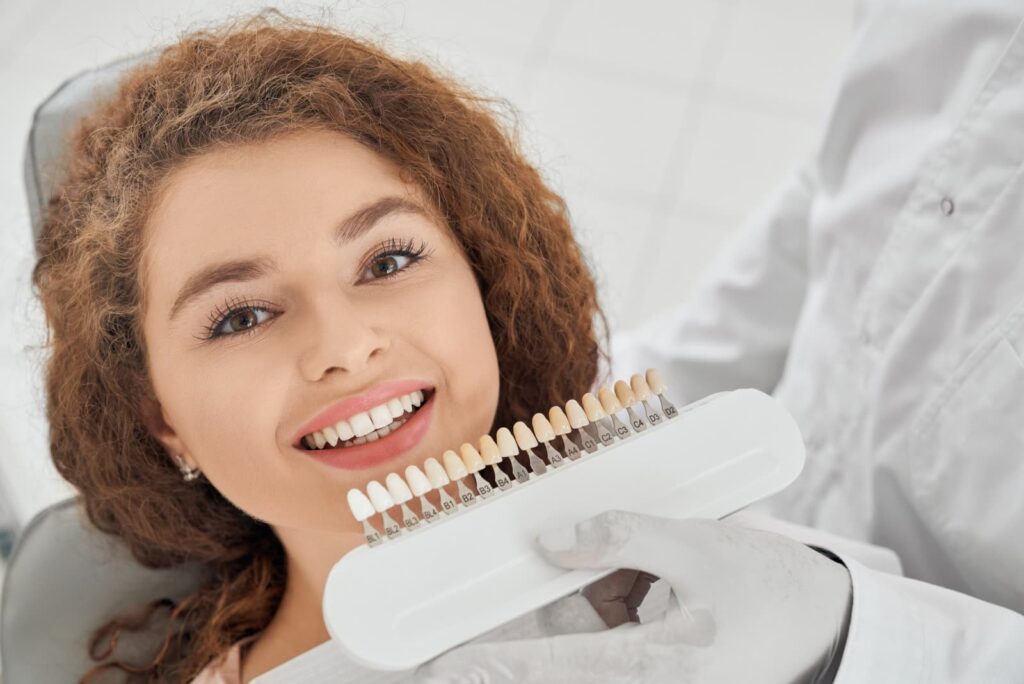
General dentists, cosmetic dentists, and prosthodontists all place dental veneers. That said, for a natural-looking result, artistry and experience with porcelain veneers matter more than a professional title alone. At Lowenberg, Lituchy & Kantor (LLK), our three cosmetic dentists work closely with a team of eight in-house lab technicians led by a master ceramist to design and create customized porcelain veneers.
Placing a veneer is only one part of creating a natural-looking smile. The result also depends on thoughtful smile design, precise preparation, and skilled porcelain fabrication. At LLK, Drs. Marc Lowenberg, Gregg Lituchy, and Brian Kantor work closely with our dental technicians, including master ceramist Jason J. Kim, CDT. Drs. Lowenberg and Lituchy have practiced together since the 1980s, while Dr. Kantor joined the team in 2002.
Our approach goes beyond improving individual teeth. We consider how the entire smile complements each patient’s facial features. Our patient Barbara shared why this matters when she recalled noticing that “my teeth didn’t go with the rest of my face.” Her experience reflects a common patient desire: a smile that looks balanced and feels naturally their own.
Yet even when patients know what they want to change, they may hesitate because they fear ending up with overly white, opaque, or artificial-looking “Chiclet” veneers. Choosing the right provider can help address that concern.
In this guide, we explain what goes into creating a believable “perfectly imperfect smile” and what to look for when choosing a porcelain veneers provider who understands your aesthetic goals.
Key Takeaways
- Any licensed dentist can place veneers. Results depend on cosmetic expertise and the dentist’s experience placing veneers.
- Dental lab craftsmanship matters. Our technicians work directly with our dentists to customize the shape, shade, translucency, and fit of porcelain veneers.
- Prep is conservative. LLK removes about half a millimeter from the outer surface only, and some cases are prepless.
- You approve the design first. Patients approve shape, size, length, and color on temporaries before the final veneers are made.
- In New York City, porcelain veneers typically cost $4,000 to $5,000 per tooth as of 2026. Your final investment depends on how many veneers you get and how complex your treatment is.
- Veneers last a long time. With care, they last 15 to 20 years, and the enamel prep can’t be reversed.
What Are Dental Veneers?
Dental veneers are thin, custom-made porcelain shells bonded to the front surfaces of teeth to improve their appearance. Also known as laminates, porcelain veneers are what we call the “Rolls-Royce of cosmetic dentistry” because of their potential for detailed customization and natural-looking results.
Porcelain veneers can correct a multitude of imperfections, including:
- Discoloration: Stained teeth take on a new, natural-looking shade.
- Misshapen teeth: Short, worn, or irregular teeth are reshaped.
- Gaps and spaces: Veneers close unwanted spaces between teeth.
- Crooked teeth: Veneers can make teeth look aligned without moving them.
- Minor misalignments: Slight rotations and crowding are masked.
The crooked-teeth point surprises many people. Veneers have the big advantage of making the teeth look aligned in a week or two, without actually moving them.
Veneers can also widen the arch, creating a fuller smile by better supporting the lips and cheeks. That’s why we plan a veneer case around your whole face rather than tooth by tooth.
Veneers can also address the appearance of an aging smile. Over time, teeth may shift, become crowded, wear down, or discolor. We consider these changes when designing veneers that complement your facial features and restore more balanced tooth proportions.
But how many veneers do people need? Generally, people need 10 veneers for the upper teeth and 8 for the lower teeth, but you don’t always have to follow that number. Some patients need only a few front teeth done. The right number depends on your smile and is decided at your consultation.
What Type of Dentist Is Best for Veneers?
The type of dentist that is best for veneers is usually a cosmetic dentist with extensive veneer experience. General dentists and prosthodontists may place veneers too, but the dentist’s aesthetic judgment, veneer caseload, the ceramist’s skill, and the team’s past results can matter more than the title alone.
It helps to know what each title means:
- General dentists handle checkups, fillings, and everyday care, and some also offer veneers. The amount of cosmetic work they do varies by office.
- Cosmetic dentists focus on how teeth look, and veneers often make up a large share of their work. Ask to see their veneer cases before you judge the title.
- Prosthodontists are specialists. The ADA News describes prosthodontics as a recognized dental specialty centered on restoring and replacing teeth, and prosthodontists complete a three-year residency after dental school.
Any of the three can place a veneer. What separates a natural result from an obvious one is the doctor’s eye, the ceramist’s skill, and the number of veneer cases the team has done. When Lizabeth Z. chose Dr. Kantor, she was impressed by his patient portfolio photos and caseload.
At LLK, we look at how each tooth fits into your overall smile, considering your dental health, facial proportions, and cosmetic goals to create a balanced, personalized result.
The best veneer providers design smiles around individual facial features rather than following a standard template. During your consultation at LLK, we consider:
- Face shape, which guides tooth length and width
- Skin tone, which helps set a shade that looks bright without looking artificial
- The whites of your eyes, another reference point for a believable shade
- Personality, since a playful, bold smile and a subtle, refined one call for different designs
The goal, as Dr. Lowenberg told Inspired Citizen, is “for you to look like yourself, only better.”
When you compare practices, look closely at their before-and-after cases. Strong results look natural and individual, and they vary from patient to patient. A gallery full of identical, uniformly white smiles tells you the dentist works from a template. Browse LLK’s photo gallery to see the range of its smile makeover results.
Who Actually Makes Your Veneers?
At LLK, our cosmetic dentists work closely with the eight technicians in our in-house laboratory to make your veneers. Our technicians carefully hand-layer feldspathic porcelain to control each veneer’s shape, shade, and translucency.
Our lab specialists include master ceramist Jason J. Kim, CDT, known as “The Maestro.” His expertise supports our team’s focus on natural-looking ceramic restorations.
Jason J. Kim’s professional background includes:
- Training: Studied under master ceramist Willi Geller from 1994 to 1997
- Leadership: Secretary/Treasurer of the Oral Design International Foundation since 1997
- Membership: The American Society for Dental Aesthetics
- Author: His first book, The Master Ceramist, and co-author of the textbook Aesthetic Restorative Dentistry: Principles and Practice
Jason is one of the best, if not the best, master ceramists worldwide, and Departures magazine dubbed him the “Picasso of his field.” The same 2013 Departures article reported that Jason had made Jerry Seinfeld’s teeth twice, the first time about 20 years earlier. That is the magazine’s past reporting, not a current patient relationship or an endorsement.
Our technicians use hand-layered feldspathic porcelain, building thin layers of ceramic to reproduce the color variations and translucency of natural teeth. This labor-intensive technique requires specialized craftsmanship and allows us to customize the optical appearance of each veneer.
In our in-house laboratory, we develop the wax-up that guides your proposed veneer design, using photographs, impressions, and other treatment records gathered at the start of the smile design process.
Because our technicians work on-site, they can collaborate directly with our dentists to evaluate shade, shape, and fit, including making appropriate refinements during an appointment when possible. Some adjustments may require additional fabrication time.
Why Do Hand-Layered Feldspathic Veneers Look More Natural?
Hand-layered feldspathic veneers can create a natural-looking smile because the ceramic’s translucency and color variations help reproduce the optical qualities of tooth enamel. Our technicians carefully build porcelain layers to control how each veneer reflects and transmits light.
Machine-milled and pressed ceramics can also produce natural-looking results, but hand-layering gives our technicians greater control over subtle color gradations and optical depth. The goal is to create veneers that complement your natural features rather than draw attention to the restorations themselves.
Our in-house technicians focus on these three qualities for each patient:
- Translucency: How much light passes through the porcelain
- Value: How light or dark the shade looks
- Chroma: How intense the color is
Small variations, such as a slightly more translucent edge, help each veneer blend with the surrounding teeth. This hand-layering is the artistry behind LLK’s “believability,” and the veneers are designed to look as though you were born with them.
How Do You Find a Reputable Dentist for Veneers?
To find a reputable dentist for veneers, choose a cosmetic practice with a high volume of porcelain veneer cases, real before-and-after results, and a preview step before anything permanent. Here’s what to look for:
- Case volume: Lizabeth Z., one of our patients, wrote on LLK’s reviews page that she consulted several practices and chose one that had performed thousands of porcelain veneer cases. She also noted that her dentist called the day after her procedure to check in.
- Who makes the veneers: Ask about the dental laboratory and how its technicians collaborate with the dentist. At LLK, our cosmetic dentists work closely with our in-house master ceramist and eight lab technicians to customize porcelain restorations and coordinate design refinements.
- A preview before you commit: During your LLK consultation, we sculpt tooth-colored composite resin directly onto your teeth so you can preview changes in shape and proportions before proceeding with treatment.
Later, you wear wax-up temporaries and approve shape, size, length, and color before the final veneers are made.
Skipping that preview can go badly. AOL reported that one patient, Heydie Reynoso, was drawn in by the low price. She also said the practice offered only a limited consultation and didn’t provide temporary veneers to let her preview the results.
- A natural result, beyond credentials: Strong credentials alone don’t guarantee a natural look. Donna O. wrote on LLK’s reviews page that a string of prior dentists “could not solve my dental issues and achieve the natural look that I wanted.”
Here are some questions to ask at your consultation:
- How many porcelain veneer cases have you done?
- Can I see before-and-after cases of real patients?
- How much enamel will you remove? (At LLK, typically about half a millimeter from the outer surface only, and sometimes none.)
- Can I approve the shape and color on temporaries before the final veneers are made?
- Is the tooth preparation irreversible? (An honest answer is yes: enamel prep can’t be undone.)
- What happens if I don’t love the result? (Listen for a clear answer about adjustments and follow-up visits.)
A reputable practice should answer these questions clearly, show examples of its work, and let you review the proposed treatment plan before making any irreversible changes to your teeth.
How Do You Avoid Fake-Looking “Chiclet” Veneers?
You avoid fake-looking “Chiclet” veneers by choosing a design built on deliberate imperfection instead of uniform, blinding-white rows. At LLK, we design our feldspathic veneers specifically to avoid teeth that look fake, Chiclet-y, and opaque.
Departures magazine described an exaggerated Hollywood smile as “a row of square white Chiclets.” To avoid that appearance, we incorporate natural-looking variations such as:
- One or two teeth slightly askew or overlapped, the way natural teeth sit
- Subtle irregularities in a few veneer edges
- A shade matched to your face, not the brightest white on the chart
Shade is where many fake-looking veneers go wrong. A brighter white isn’t always better. We select a veneer shade that complements your skin tone, the whites of your eyes, and your age, then confirm it with your temporary veneers before fabricating the final restorations.
The real test is how people react. LLK wants people to say things like “Wow! You look great!” or “You look refreshed!” and not “Did you have your teeth done?”
The design can also change after placement. Dr. Gregg Lituchy told Coveteur that if a patient says a set is “too white for me,” he can drill the veneers off and make another set. In his words, that’s design flexibility, not a guarantee, a free redo policy, or a promised outcome.
What Happens During the Veneer Procedure?
During the veneer procedure, we typically start with a cosmetic consultation and live smile preview, followed by two treatment appointments about one to two weeks apart. At the first treatment visit, we prepare your teeth as needed and place temporary veneers. At the second visit, we evaluate the veneers and bond them to your teeth once we confirm they fit and look right. Additional appointments may be necessary depending on your individual needs.
What Happens at the First Veneer Visit?
At your first treatment visit, your dentist lightly roughens and drills the tooth enamel to prepare it for the veneers. Then, you leave the office with temporary veneers.
Here’s what typically happens during this visit:
- Numbing: The dentist numbs the teeth with local anesthesia before starting any preparation.
- Preparation: The doctor removes about half a millimeter of tooth enamel from the outer surface only. Some cases need no preparation at all, which we call prepless veneers.
- Temporaries: Wax-up-based temporary veneers go on during the same visit.
After preparing your teeth, we take impressions or other appropriate records to guide our dental technicians as they create your custom veneers.
When veneer placement requires enamel removal, the change is irreversible because natural enamel does not grow back. However, the veneers themselves are replaceable and typically last 15 to 20 years with proper care.
Many people picture far more drilling than actually happens. In reality, it usually involves removing about half a millimeter from the outer surface of the tooth when preparation is needed. Some patients may qualify for prepless veneers.
You then wear the temporary veneers for approximately two weeks, giving you time to evaluate their shape, size, length, and overall appearance. We use your feedback to refine the approved design and guide the fabrication of your final porcelain veneers in our in-house laboratory.
What Happens During Veneer Placement?
Veneer placement is the second of two office visits. It happens after two weeks of wearing the temporaries, once you’ve approved the design.
The bonding steps we may use include:
- Sterilize the teeth with an antibacterial solution.
- Etch the teeth to prepare them for the bonding agent.
- Apply the bonding agent.
- Seat the veneers with resin cement.
- Harden the cement with a dental curing light, then clean away excess material.
Before bonding, we evaluate each veneer’s fit, shade, and appearance. Our in-house laboratory team can collaborate with us on any necessary refinements, although some adjustments may require additional fabrication time.
After placement, we aim to ensure your bite feels comfortable and your veneers function naturally when you eat and chew. About a week after placement, your doctor may adjust the bite (occlusion) of your new teeth.
The two-visit process can help you plan your new smile around a big event, as Tina did for her wedding. In her LLK patient story, she says: “That’s how I wanted them to look when I walked down the aisle.” LLK notes that some patient stories are dramatized.
How Much Does a Decent Set of Veneers Cost?
A decent set of porcelain veneers in NYC can cost about $4,000 to $5,000 per tooth as of 2026. A complete smile makeover with about 18 veneers may cost $72,000 to $90,000. Your actual investment depends on the number of teeth treated, the complexity of your case, and your personalized treatment plan.
| Cost factor | NYC market context (as of 2026) |
|---|---|
| Per tooth | $4,000 to $5,000 |
| Typical count | About 10 upper and 8 lower veneers, though this number doesn’t always apply |
| Full-set total | Depends on how many teeth you treat; set at your consultation |
The number of veneers you need is the biggest driver of veneer cost, since veneers are usually priced per tooth. If you need only a few front teeth done, the total is lower.
The material and fabrication technique also affect treatment costs. Hand-layered feldspathic porcelain requires specialized craftsmanship and additional lab work. Our dentists collaborate with our master ceramist and the technicians in our in-house laboratory to customize each restoration to your facial features and approved smile design.
Cost matters, but we see veneers as an investment in something you use every day: your smile. Your smile is your calling card, whether you’re in a job interview, on a first date, or just going about your day.
The total cost depends on how many veneers you need and how complex your case is. We’ll discuss your treatment plan and provide pricing during your consultation. As one patient shared on our reviews page, “It was money well spent.”
How Strong Are Porcelain Veneers?
Porcelain veneers are strong and durable and can last 15 to 20 years with proper care. Some may last up to 30 years, but results vary based on oral hygiene, bite forces, habits, and other factors. If one wears or chips, you can replace it.
Porcelain veneers are also highly resistant to staining. As our FAQ explains, “Veneers don’t stain… and essentially won’t stain for over a decade.” In contrast, whitened natural teeth can become discolored again within a few months, particularly with frequent consumption of coffee, tea, or red wine.
Even with proper care, veneers may eventually need replacement. One Yelp reviewer shared that when a veneer cracked after 15 years, we scheduled an appointment for the next day and fitted a matching temporary veneer while the replacement was being made.
How Do You Care for Porcelain Veneers?
Veneers need the same daily oral hygiene as natural teeth. According to Cleveland Clinic, brushing, flossing, and regular dental visits are all you need to keep veneers in good condition, using a soft-bristled toothbrush and non-abrasive fluoride toothpaste.
Routine hygiene visits also let your hygienist check the gums around each veneer. Cleveland Clinic adds a few habits that help veneers last:
- Skip whitening products. Cleveland Clinic says to avoid whitening products, as they can scratch your veneers.
- Go easy on hard foods. Avoid biting directly into hard or crunchy foods.
- Don’t use your teeth as tools. That means no opening packages or tearing off clothing tags.
- Rinse. Use antibacterial mouthwash twice a day to support healthy gums.
If you grind or clench your teeth, we may recommend a custom nightguard to help protect your veneers. For example, our patient Jeff had worn and chipped his front teeth through grinding. We restored their appearance with porcelain veneers and provided a protective nightguard to help reduce further wear.
Why Do Dentists Discourage Veneers?
Dentists discourage veneers when a patient isn’t a good candidate, not because well-made veneers harm healthy teeth. Our guidance on when veneers may not be suitable identifies the following situations:
- Teeth that are extremely weak or decayed
- Too little tooth surface for a veneer to bond to
- Gum disease
The enamel preparation is irreversible. The prep itself is conservative: about half a millimeter from the outer surface only, and sometimes none. A doctor who recommends against veneers for healthy, well-supported teeth may be weighing that irreversibility against what you want to change, which is a conversation worth having at the consultation.
Some doctors also suggest a smaller fix first. If you have one chipped tooth or a single small gap, bonding may be enough. If your concern is color alone and your teeth respond well to bleaching, whitening may be enough. Veneers make the most sense when you want to change color, shape, size, and alignment at the same time.
If gum disease or tooth decay is a factor, LLK has a periodontist and an endodontist on staff who can treat it first under one roof. Our in-house periodontist and endodontist can help evaluate and manage appropriate periodontal or endodontic concerns. During your consultation, we assess your oral health and determine whether veneers are suitable.
Teeth grinding doesn’t rule out veneers. We treat patients who grind with veneers plus a protective guard worn at night.
Porcelain veneers involve a significant financial investment, typically $4,000 to $5,000 per tooth in New York City as of 2026. Other considerations include irreversible enamel preparation when required and the potential need to replace veneers over time.
How Do Veneers Compare With Crowns, Bonding, Whitening, and Orthodontics?
Compared with crowns, bonding, whitening, and orthodontics, veneers address several cosmetic concerns at once, including tooth color, shape, size, gaps, and apparent alignment. Each alternative addresses a different or narrower set of concerns, as the table below shows.
| Option | What it changes | Time to result | Main trade-off |
|---|---|---|---|
| Porcelain veneers (LLK service) | Color, shape, size, gaps, apparent alignment | Initial consultation, then typically two treatment visits one to two weeks apart | Cost: $4,000 to $5,000 per tooth in NYC (as of 2026) |
| Dental crowns | Color, shape, size, strength | Varies by case | Covers the entire tooth, not only the front |
| Dental bonding (LLK service) | Chips and small gaps | One visit, immediate | Lasts a limited time; can chip or stain |
| Teeth whitening | Color only | Varies by method | Color can fade within 1 to 18 months |
| Braces or clear aligners | Tooth position | Often months or longer | Doesn’t change color or shape |
- Crowns vs. veneers: A dental crown covers the entire tooth structure, while a veneer covers only the front, according to the Cleveland Clinic. Veneer prep takes about half a millimeter off the outer surface, and sometimes none.
- Whitening vs. veneers: Whitening results tend to fade anywhere between 1 and 18 months, while veneers essentially won’t stain for over a decade. LLK patient Amy learned this firsthand: her story describes a vicious cycle of bleaching her teeth every few months before she turned to veneers.
- Bonding vs. veneers: At LLK, bonding is painless and typically anesthesia-free, with immediate results in one visit. It lasts a limited time, though, and can easily chip or stain. Bonding suits small repairs; veneers suit a smile makeover across several teeth.
At LLK, we consider both your oral health and cosmetic goals when recommending treatment. The right option depends on your teeth’s condition and the changes you want to achieve. Many patients combine cosmetic procedures, for example, bonding a small chip on one tooth while planning veneers for the front teeth.
Veneers make teeth look aligned in a week or two without moving them, a result some call “instant orthodontics.” As Jon put it in his patient story, “it only took two weeks, not two years.” Orthodontic treatment works differently because it physically moves teeth into new positions over time.
Who Does Veneers for Celebrities, and for Everyone Else?
Drs. Marc Lowenberg, Gregg Lituchy, and Brian Kantor do veneers for celebrities and everyone else at LLK. Drs. Lowenberg and Lituchy have led cosmetic dentistry since the 1980s, with Dr. Kantor joining the practice in 2002. Their work for public figures earned them the nickname “dentists to the stars.”
Coveteur has reported that its client roster includes Heidi Klum, Naomi Campbell, Cindy Crawford, Chris Rock, and Julianna Margulies, as well as the entire New York Knicks team. That’s past reporting, not a current endorsement. Martha Stewart has written on her own blog that she has “been going for 20 years” to the practice.
Eileen Ford, the founder of the Ford Modeling Agency, entrusted us with model Zora’s smile. We used upper and lower porcelain veneers to improve her smile. Our doctors have also appeared on television programs including Good Morning America and The View.
Celebrity patients represent only about 1% of the people we treat. Our commitment to every patient is the same. We put every bit as much care into creating a smile for a social worker, a lawyer, a secretary, anyone.
Why Does a Three-Dentist Team Matter for Your Veneers?
Our three-dentist approach brings the combined judgment of Drs. Marc Lowenberg, Gregg Lituchy, and Brian Kantor to each veneer case. We work as an “ego-less team,” sharing clinical and aesthetic perspectives to develop a coordinated treatment plan.
While our doctors are known as “celebrity dentists,” we prioritize helping every patient feel confident in their smile. We approach each veneer case as a team, combining the expertise of all three partners to provide personalized care and achieve natural-looking results.
As they’ve mentioned, “We work as a team, and all contribute our input to every case. Every patient here is ‘our’ patient collectively.”
All three doctors hold a DDS and are members of the American Dental Association (ADA). Drs. Lowenberg and Lituchy have practiced since the 1980s, and Dr. Kantor joined in 2002.
Can You Get Veneers If You’re Afraid of the Dentist?
You can get veneers if you’re afraid of the dentist. Dental fear doesn’t rule you out. Veneers are placed over two office visits, both performed under local anesthesia, and the consultation happens before anything is prepared.
You’re far from alone. An NYU College of Dentistry study of 1,003 U.S. adults, published in the Journal of the American Dental Association, found that 72.6% reported some amount of dental fear, and that most fearful individuals are interested in treatment to overcome it. The researchers also note that anxious people often skip routine care until a problem appears, which can make the next visit feel even harder.
Plenty of LLK patients started out afraid. Susan F. wrote on LLK’s reviews page: “I had an intense fear of Dentists; bad childhood experiences, and hadn’t been for years.”
In Whitney’s patient story, she describes a fear of going to the dentist that kept her away even though she was in pain every day and ashamed to open her mouth to speak or smile. LLK notes that patient stories may be dramatized, but the pattern will sound familiar to anyone who has put off a visit for years.
A few things make veneers more manageable for an anxious patient:
- A preview first: The consultation preview is temporary and removed before you leave, and you won’t have anything prepared that day.
- Local anesthesia: Both treatment visits use local anesthesia.
- A short timeline: The whole veneers placement process takes two visits, a week or two apart.
The setting helps, too. Bonnie wrote that the office “feels like home,” and Ellyn S. has been going to Dr. Lowenberg and the team for 33 years.
How Do You Schedule a Veneer Consultation With LLK?
Call LLK at (212) 586-2890 or use the contact form to schedule a consultation. Our office is located at 230 Central Park South, New York, NY 10019, overlooking Central Park.
During your consultation, we’ll discuss what you’d like to change and evaluate whether porcelain veneers are right for you. We can also demonstrate the proposed smile design with temporary composite resin, so you can preview changes in shape and proportions before deciding whether to proceed.
Bring a few things to the consultation: photos of smiles you like (and dislike), a list of what bothers you about your teeth, and any questions about timing, for example, a wedding or event date. The doctors can then tell you whether veneers suit your teeth, how many you’d likely need, and what the two visits would involve.
Explore our photo gallery to see examples of our smile makeovers. When you’re ready, schedule a consultation to learn how we can design a “perfectly imperfect” smile that fits your features and goals.
Frequently Asked Questions About Who Does Veneers
Do they pull teeth to put in veneers?
Porcelain veneers generally do not require tooth extraction because they bond to the front surfaces of your existing teeth. At LLK, we use a conservative preparation approach, typically removing about half a millimeter from the outer tooth surface when necessary. Some patients may qualify for prepless veneers that require no enamel removal.
Enamel prep can’t be undone, but veneers typically last 15 to 20 years and can be replaced. Your tooth stays in place: the root and most of the tooth structure remain, and the veneer covers the front surface. If a tooth is too weak or decayed to support a veneer, your dentist will tell you at your consultation and discuss other options.
Does dental insurance cover veneers?
Dental insurance typically doesn’t cover veneers. Cleveland Clinic notes that dental veneers are cosmetic treatments and most insurance plans don’t cover them. Coverage varies by policy; confirm the details with your insurer.
In New York City, porcelain veneers typically cost $4,000 to $5,000 per tooth as of 2026. Your total investment depends on how many veneers you want and your individual treatment needs. During your consultation, we’ll evaluate your smile, explain the proposed treatment plan, and discuss the expected costs.
Are dental implants better than veneers?
Neither is better, because dental implants and veneers solve different problems. A dental implant replaces a missing tooth root, while veneers cover the front of healthy teeth you still have, according to Cleveland Clinic. Veneers may not suit teeth that are extremely weak or decayed.
At LLK, we provide implant restorations and have an in-house periodontist to help coordinate appropriate care. During your consultation, we’ll evaluate your dental health and discuss the best treatment for your needs.
Some smiles may need both: an implant to replace a missing tooth and veneers on neighboring teeth, designed together to match color and shape.
Can a general dentist or prosthodontist do veneers?
Any licensed dentist can place porcelain dental veneers, but results depend on cosmetic training and veneer experience. Prosthodontics is an ADA-recognized specialty in restorative dentistry, and prosthodontists complete a three-year residency after dental school, accredited by the Commission on Dental Accreditation.
At LLK, Drs. Marc Lowenberg and Brian Kantor earned their dental degrees at NYU, while Dr. Gregg Lituchy graduated from Columbia. During your consultation, our team evaluates your dental health, cosmetic goals, and treatment options to determine whether porcelain veneers are appropriate.
Are composite veneers a good alternative to porcelain veneers?
Composite veneers generally cost less upfront than porcelain veneers, but they stain more easily, wear faster, and may require more frequent maintenance. Composite veneers are also not translucent, while hand-layered feldspathic porcelain allows greater control over translucency, optical depth, and subtle color variations.
At LLK, eight technicians craft custom porcelain veneers in our in-house laboratory. While we do not offer composite veneers, we use composite resin bonding to repair minor chips, close small gaps, and make other localized cosmetic improvements.